Beard and Moustache Transplant
Single grafts placed at a sharp angle for natural direction, with density expectations set from the outset.
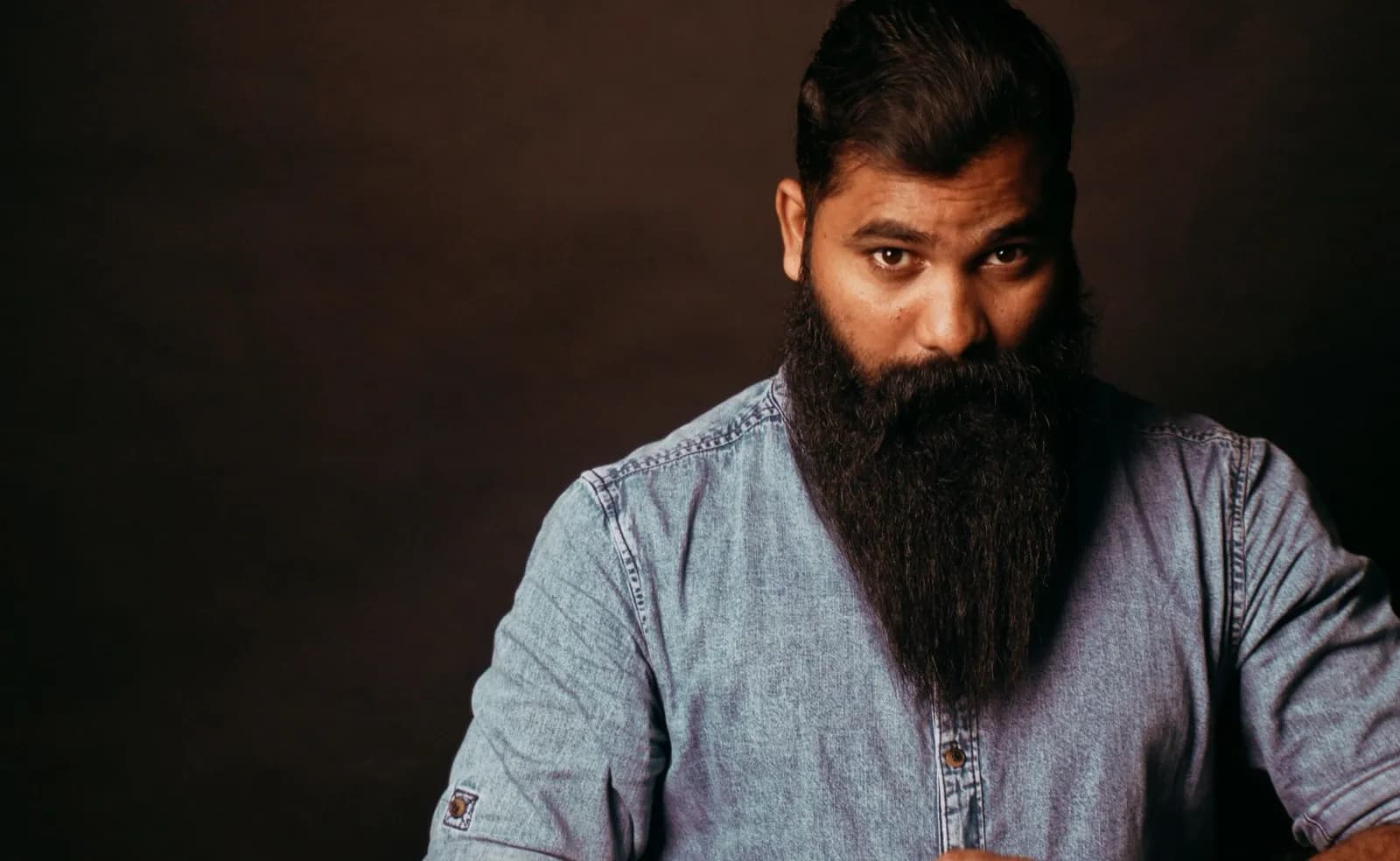
Know what to expect over 12 months
A beard and moustache transplant places follicular units — usually taken from the scalp donor area (back/sides) — into patchy, gap-filled, or scar-affected hairless areas of the face. Facial hair emerges at a markedly different angle and direction than scalp hair; along the jawline, cheek, and upper lip, hair grows at an almost flat angle, nearly parallel to the skin. Each follicle is therefore placed individually, following the angle and direction specific to that zone.
A natural look in the beard area depends on hairs being placed parallel to one another in a consistent, orderly direction, which makes this a more time-consuming, detail-intensive procedure than a scalp transplant. Density expectations are clarified with the patient before the procedure based on existing scar tissue, hair shaft thickness, and donor capacity; reaching the same density in every zone isn't always possible.
This method suits men with sparse, patchy, or scar-affected beard/moustache areas resulting from surgery or injury. Donor capacity needs to be assessed alongside any hair-transplant needs; if the same donor area will be used for both hair and beard, priority planning is done in advance.
Who Is It Suitable For?
Suitable
- Patients with patchy, sparsely growing beard or moustache areas
- Patients with hairless zones on the jaw, sideburns, or upper lip resulting from surgery, burns, or injury
- Men whose beard growth is genetically limited and whose hormonal maturity is complete (typically over age 20)
- Patients wanting to balance an asymmetric density difference in the moustache or jawline
- Patients whose donor area (scalp) has density sufficient for beard needs
- Patients who haven't had success with temporary solutions (makeup, styling) and want a permanent option
Not Suitable
- Patients whose donor area can't meet both hair and beard needs, where a hair transplant takes priority
- Anyone with active acne, eczema, psoriasis, or another skin condition on the face
- Patients known to have a tendency toward keloid (excessive scar) formation
- Younger patients whose beard growth hasn't fully developed yet
- Patients with density expectations that don't match their available donor capacity
How Is It Performed?
- Design and mapping — Facial features, current beard density, and gap areas are assessed, and the jaw, sideburn, and moustache line are marked to the millimetre.
- Local anaesthesia — Both the donor (back/side scalp) and recipient (face) areas are numbed.
- Donor extraction — Follicular units are removed one at a time from the scalp donor area with an FUE punch.
- Graft sorting — Follicles are examined under a microscope and sorted by direction and thickness.
- Channel opening — Micro-channels are opened in the facial skin at a low angle and direction specific to the zone.
- Placement — Each follicle is placed individually to match the natural growth direction of the jaw, sideburn, or moustache line.
- Wash instructions and check-up — Aftercare instructions are given at the end of the procedure, and a follow-up plan begins.
How It Differs From Other Techniques
| Feature | Beard and Moustache Transplant | Standard FUE (Scalp) | Eyebrow Transplant |
|---|---|---|---|
| Hair growth angle | Almost parallel to the skin, sharp | Moderate angle following scalp curvature | Very low, near-horizontal angle |
| Graft type | Mostly single-to-double follicle | Mixed single-to-multi follicle | Single follicle only |
| Procedure precision | High — direction/angle varies by zone | Moderate — broad-area planning | Very high — arc-tracking |
| Donor source | Scalp (back/sides) | Scalp (back/sides) | Scalp (back/sides) |
| Procedure length | Moderate-to-long, depending on graft count | Varies with graft count | Few grafts, long detailed work |
| Tolerance for visible risk | Low (facial area is highly visible) | Moderate | Very low |
Recovery Timeline
| Period | Expected State |
|---|---|
| Day 0-3 | Mild redness, small scab points, sensitivity |
| Week 1 | Scabs begin to shed; the transplanted area looks close to normal |
| Month 1 | A shock-loss phase may occur; transplanted hairs may shed and re-enter the growth cycle |
| Month 3 | New hair growth becomes noticeable |
| Month 6 | Density increase becomes clear; first shaping trims can be done |
| Month 12 | The permanent result settles; the natural growth angle fully establishes |
Three photos are enough
Send three photos — front, crown and back. You'll receive your donor capacity, graft range and suitable technique within 24 hours.
Request a free analysis
Graft Range and Donor Capacity
The number of grafts used in a beard and moustache transplant depends on the size of the gap and the targeted density; a limited jaw area might be supported with a few hundred grafts, while extensive beard restoration can require more. Donor capacity is never assessed independently of hair-transplant needs — since the same back/side scalp area supplies both purposes, both current and possible future hair-transplant needs are planned together. For this reason, donor density is mapped at the initial consultation and priorities are clarified with the patient. Outcomes vary from person to person, depending on skin type and existing hair shaft thickness.
See your graft range for this technique
Your loss pattern and donor density produce a range, a suitable technique and an estimated session length. The final plan comes from a photo assessment.
Frequently asked about this treatment
Most of the transplanted follicles keep growing, retaining the genetic characteristics of the donor area they came from, which is why the outcome is considered permanent. That said, the final look varies from person to person depending on skin structure, hair thickness, and grooming routine — regular shaving and care affect the long-term appearance.